


Page 63 - MOWO186
P. 63
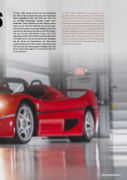
des F50 auf dem Genfer Autosalon die Nachfolge
seines legendären F40. Der F50 war nicht nur
SIm Jahr 1995 feierte Ferrari mit der Enthüllung
ein würdiger Nachfolger, sondern setzte neue
Maßstäbe: Seine Technik und sein Design waren
stark von der Formel 1 inspiriert, was ihn zu einem
der faszinierendsten Supersportwagen seiner Zeit
machte. Das Herzstück des F50 war ein V12-Motor,
der aus Ferraris 642-Formel-1-Auto von 1991
abgeleitet wurde. Mit 512 PS, einer Höchstdrehzahl
von 8.000 U/min und einem betörenden Klangbild
bot der Motor ein Fahrerlebnis, das dem eines
straßenzugelassenen Rennwagens gleichkam. Der
F50 erreichte eine Höchstgeschwindigkeit von 325
km/h und beschleunigte in nur 3,8 Sekunden von
0 auf 100 km/h.
In 1995, Ferrari celebrated the successor to its
legendary F40 with the unveiling of the F50 at the
Geneva Motor Show. The F50 was not only a worthy
successor, but also set new standards: its technology
and design were heavily inspired by Formula 1, making
it one of the most fascinating supercars of its time. At
the heart of the F50 was a V12 engine derived from
Ferrari’s 642 Formula 1 car from 1991. With 512 hp, a
maximum speed of 8,000 rpm and a beguiling sound,
the engine offered a driving experience on a par with
that of a road-legal racing car. The F50 reached a top
speed of 325 km/h and accelerated from 0 to 100
km/h in just 3.8 seconds.


